Photography
Art direction
Photographing cloth

Textile work is the hardest thing I art direct. Cloth is a three-dimensional object that we insist on flattening, and almost everything that makes a weave worth looking at lives in the dimension you are throwing away.
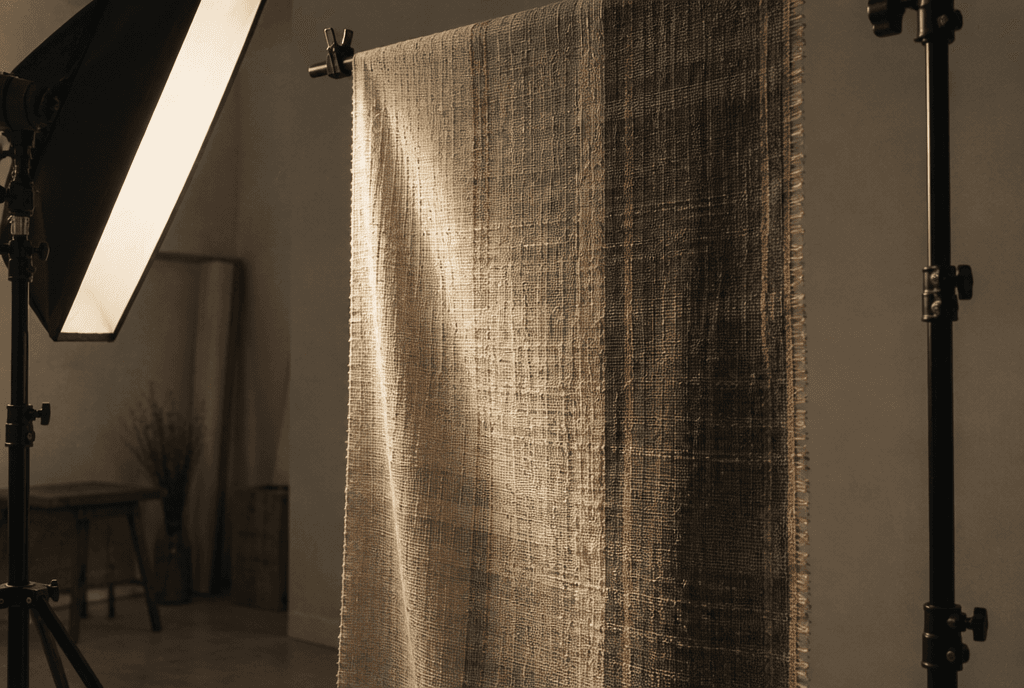
Weave is a lighting problem
A flat frontal light will render a hand-woven cloth and a printed imitation of that cloth almost identically. The difference between them is entirely in how the raised threads catch light from the side. Move the key light to a raking angle and the structure appears — the over-under, the slight irregularity where the weaver’s tension changed, the places where the pattern does not quite repeat.
That irregularity is the value. It is the proof of the hand. Light it flat and you have photographed a pattern; light it raking and you have photographed a process.
Shoot the cloth before the garment
On the Adaeze campaign we spent the first two days shooting nothing but macro frames of eleven weaves, printed them large, and then used those prints as the backdrops for the garment photography. The clothes were shot in front of enormous images of their own material.
It sounds like a gimmick and it nearly was. What saved it was scale — at that size the weave stops reading as pattern and starts reading as landscape, and the garment in front of it reads as something that came out of a place rather than off a rail.

Caption the archive
Every look in that campaign carried the pattern name and the decade it was first woven. Two lines of type. They did more work than any of the photography, because they turned a fashion image into a claim about continuity that the viewer could check.
Previous article

Next article

Got a brand that deserves to be remembered?
I take on a limited number of projects each quarter so every one gets my full attention. Tell me what you’re building and let’s see if we’re a fit.


